
When Intelligence Becomes Embodied

We spoke to Alexa, typed into ChatGPT, or engaged with AI generated recommendations in web apps. But at its core, AI remained reactive: waiting for input. Wearable devices, however, allows AI to act proactively.
After its first wave in the cloud and on screens, AI is now finding its voice, eyes, and touchpoints through hardware we wear. As a16z puts it, “AI needs a body.” It’s not enough to talk to a chat bot; most people will also want passive inputs, and hardware might be the only way to collect them effectively. AI becomes transformative when embodied in devices that see, hear, sense, move with us, and respond in real time, often without needing a screen or keyboard.
This shift marks a pivotal moment in computing, potentially as transformative as the mobile revolution. And startups and tech giants alike are pushing this vision.
Embodiment = Hardware + Intelligence
At a high level, there are two engines of differentiation: hardware design and the underlying AI models.
A big part of the emerging AI-wearables wave is hardware craftsmanship: industrial design, ergonomics, sensors, battery efficiency, and how the device fits into a user’s daily flow. The winning products won’t just be “AI in a box”; they’ll be devices where form, interaction patterns, and sensor placement are intentionally engineered to support new behaviors. Subtle details, such as latency, comfort, input pathways, ambient capture quality, become core to unlocking real usage.
On the AI layer, most devices are still relying on similar frontier or near-frontier models. Model capability alone hasn’t created large structural differentiation:
reasoning ability is converging across leading labs,
speech → vision → multimodal perception is becoming table stakes,
and most systems still rely on cloud + lightweight on-device inference.
What is emerging is each device’s context and memory architecture: how it captures, stores, and recalls personal context over time. But this layer is still early; no one has fully cracked persistent memory, privacy-safe personalization, or long-horizon behavioral modeling.
Right now, AI modalities (voice, vision, gesture, environment sensing, etc.) are powerful but familiar. The next leap comes when a particular hardware form factor combines with a model’s capabilities to unlock a completely new modality of interaction.
When hardware enables a modality the software alone cannot, the product gets non-linear upside. That’s where the “huge potential” is.
The Current Landscape
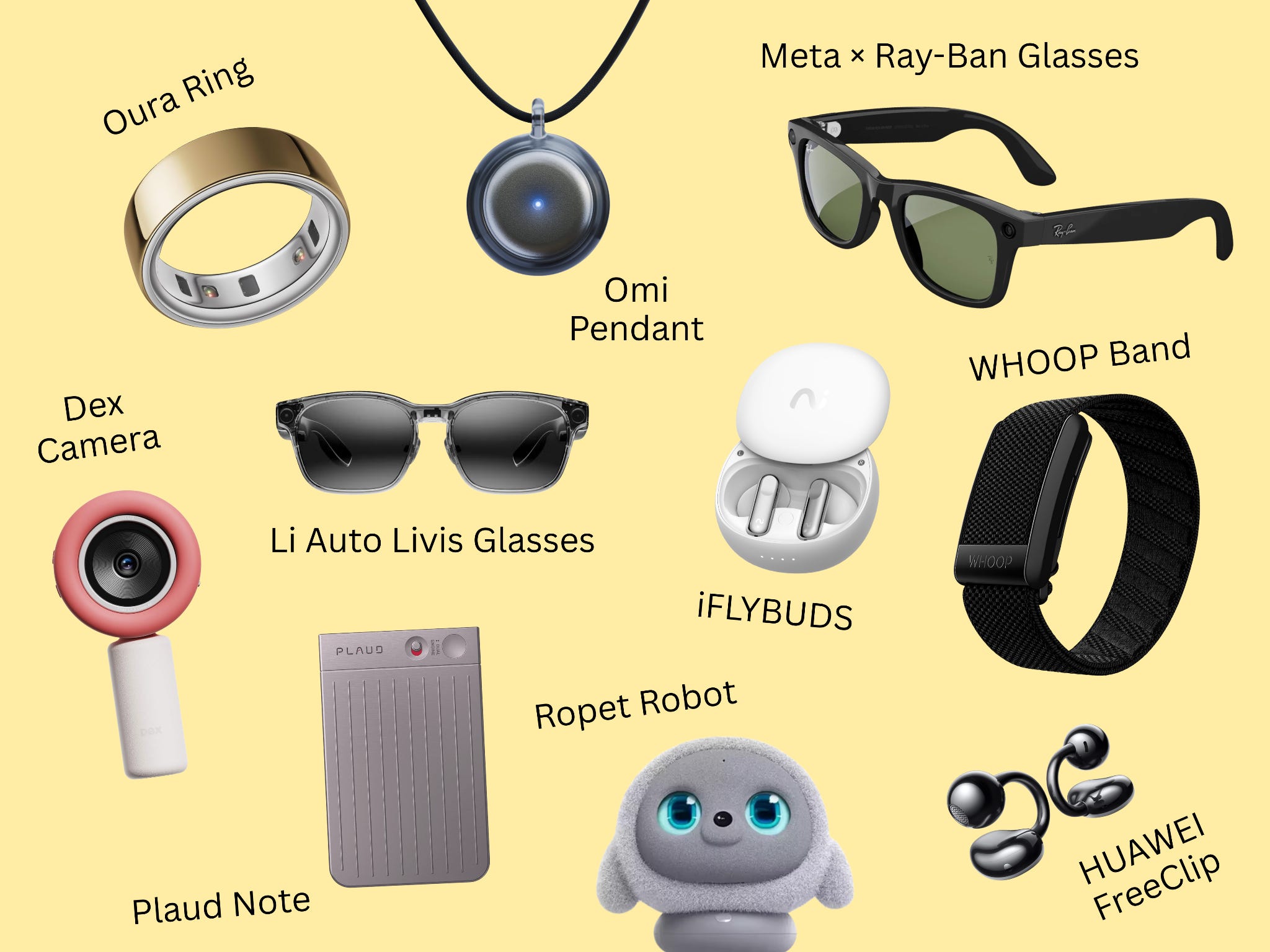
Here’s a snapshot of key categories and standout devices in the AI-wearable ecosystem:
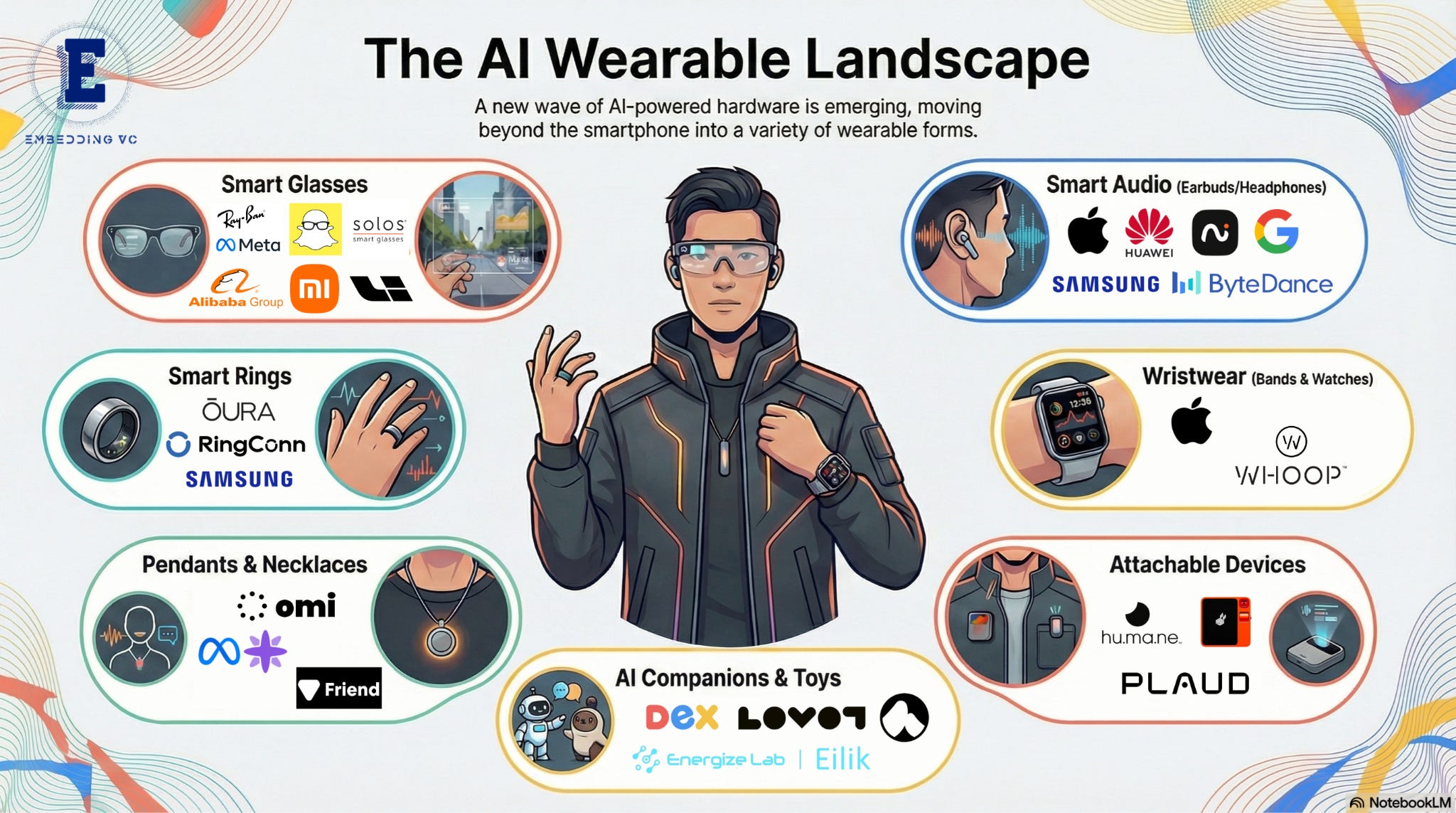
AI-Centric Glasses
Hands-free visual and audio interfaces designed for capture, assistance, and early AR use cases.
AI Earbuds / Headphones
Audio-centric wearables emphasizing voice interaction, translation, and real-time assistance.
Smart Rings
Minimal, passive wearables designed for continuous sensing and health insights.
Wristbands & Smartwatches
Mature wearables evolving toward proactive, AI-driven coaching and health insights.
AI Necklaces / Pendants
Always-on, ambient devices designed to capture context, conversations, and memory.
Omi Pendant (backed by Embedding VC)
Other Wearable / Clip-On Devices
New form factors experimenting with minimal-interface or screenless AI interaction.
Companion & Toy-Like AI Devices
Emotion-first AI products exploring companionship and social bonding.
Dex (backed by Embedding VC)
Why This Is Possible: Enabling Technologies
AI wearables are becoming viable thanks to progress in edge computing, model efficiency, and tighter integration with the cloud. Most devices today remain connected-first, relying on cloud models for heavy lifting, but modern chips like Apple’s Neural Engine and Qualcomm’s Snapdragon line (used in Meta Glasses and many AI devices) can now handle lightweight, latency-sensitive tasks locally. Combined with model-compression techniques (quantization, distillation, pruning), smaller models like Gemini Nano, Qwen-Tiny, and OpenAI’s OSS lightweight models can run partially on-device or at the edge, reducing round trips to the cloud. In practice, this hybrid setup lowers latency, improves reliability, and enhances privacy, even as more complex reasoning and generation continue to live in the cloud.
Another key driver is the maturation of China’s hardware ecosystem and supply chain. Hardware development has historically been slow, expensive, and high-risk. But China has transformed this into a highly structured, standardized, and low-risk manufacturing pipeline, especially for mature form factors like glasses, earbuds, pendants, and pocket devices. Everything from components to industrial design to tooling to first-production runs now follows an optimized, repeatable process. This infrastructure dramatically lowers the barrier for AI wearable startups, allowing them to iterate quickly and ship polished hardware without the traditional multi-year, multimillion-dollar overhead. (For deeper context, Dan Wang’s Breakneck: China’s Quest to Engineer the Future is a great read.)

The final set of enablers includes sensor fusion, energy management, and privacy safeguards. Today’s devices blend inputs from cameras, microphones, GPS, inertial sensors, and biometrics to build rich real-time context, letting glasses, earbuds, and necklaces respond naturally to what you see, hear, or feel. Improvements in batteries, power-efficient NPUs, and “always-on” microcontrollers make all-day usage realistic. And with encryption, secure enclaves, offline inference, and visible capture indicators, companies are designing privacy into wearables from day one.
Future Outlook
In the next couple of years, AI hardware will evolve from prototypes into polished consumer products. Smart glasses will be the most visible step forward. Big companies are all pushing toward stylish eyewear that can handle calls, music, translation, and lightweight AR overlays. Smartphones will remain the AI hub, with on-device LLMs powering private assistants and personalized experiences, while watches, rings, and earbuds steadily gain intelligence, acting as coaches, translators, and even subtle hearing aids. These early rollouts won’t feel like a revolution, but they will normalize AI as a constant presence across the devices we already use.
Looking two to five years out, the experience could become far more ambient. Instead of pulling out a phone, consumers may rely on AI-native form factors: either a coordinated set of wearables or a new, quietly ambient device. Whether spread across glasses, earbuds, and rings, or converged into a single lightweight, socially acceptable enough, and even fashionable piece of hardware, the experience becomes always-on but non-intrusive, with AI operating seamlessly in the background. Computing shifts from screens to spatial interfaces, with overlays and holograms woven into daily life. By then, millions could offload memory, navigation, and even decision-making to AI companions that see, hear, and remember alongside them, grounded in continuously updated world models of their surroundings and habits.
Longer term, this trajectory points toward the early stages of a post-smartphone era. Phones will still exist as hubs, but the primary interface could be wearable, context-aware devices that blend into our routines. Prices will fall, adoption will scale, and even early brain-computer interfaces may enter the picture for gaming or accessibility. As these technologies mature, new norms around privacy, etiquette, and dependence will take shape. The big picture is clear: AI won’t just live on screens; it will live with us, embodied in the hardware we wear every day.
What It Means and What’s at Stake
The rise of AI hardware could trigger platform wars on par with the smartphone era. Companies are racing to establish ecosystems around wearables, knowing that whoever controls the operating system and developer community will own the future of consumer data and services. Much like iOS vs Android, we could see closed vs open strategies play out. For product developers, this era demands hardware–software co-design: industrial design, HCI, AI models, and chip engineering working in sync.
From an investing standpoint, AI hardware is a high-risk, high-reward bet. Startups like Humane and Rabbit have shown how capital-intensive and unforgiving the hardware game can be, but the payoff—owning a piece of the “iPhone of AI”—is enormous. Expect more corporate venture arms, strategic partnerships, and M&A as larger players look to secure IP, talent, and distribution. Adjacent areas like semiconductors, batteries, and sensor innovation also offer fertile ground. Business models will evolve too: hardware margins alone won’t cut it, so expect subscriptions, bundled AI services, and even advertising experiments in new-modality environments.
Overlaying all of this are policy and ethical considerations: privacy, safety, and equity in access. Companies that lead with trust and responsible design could gain not just market share but also long-term resilience in what promises to be one of the most consequential platform shifts of the decade.
In Summary
We’re witnessing a moment where AI breaks free from screens and becomes *present*. The ascendance of AI in consumer hardware is not just a technological shift but a strategic inflection point for the tech industry. The coming years will reveal which visions turn into reality, but one thing is clear: the devices getting ready to adorn our eyes, ears, and wrists may well redefine the relationship between humans and AI, ushering in an era where technology is more personal, proactive, and seamlessly woven into our world than ever before.